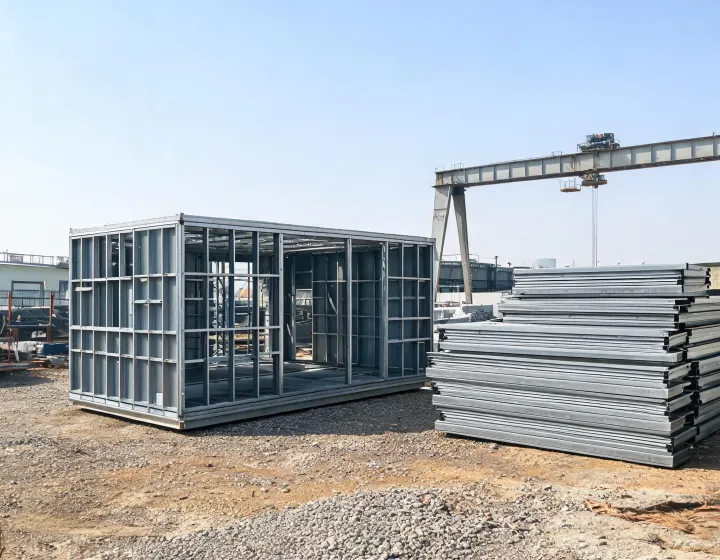
Offsite methods
Volumetric modules, panelized walls, folding units, and rigid-frame steel systems can all appear in a search for a finished building. They do not share a transport envelope, a site crew, or a drawing set. This page keeps those differences in view before a quotation is accepted as an alternative. A sample volumetric file, not a built project, might be 12 ft wide by 40 ft long by 11 ft high in transit, opening to a 24 ft by 40 ft floor, design live load 40 psf, wind speed 110 mph, exposure B, ground snow load 20 psf, seismic design category B, crane pick of 18 tons at a 30 ft radius, quantity 4 modules. A 13 ft gate beside a 12 ft module is not a route approval: packaging, turns, overhead clearance, permits and carrier survey still require confirmation. If the pick radius grows to 70 ft, the crane lift plan may erase the site-hour advantage, and a panelized or rigid-frame alternative with 20 ft bay spacing should be priced beside it. Standard catalog width versus a custom 28 ft module is the same kind of split, and a shell module price is not a turnkey set price.
Send Project Requirements
| Transport envelope | Width, height, and length must fit the route. A finished room that exceeds the road limit is not a savings in site time. |
|---|---|
| Crane lift plan | Pick weight, radius, and pad bearing are project items. Ask who supplies the crane and whether the quote includes the lift. |
| Interfaces | Mating lines between modules, MEP stubs, and the foundation interface need a tolerance. A brochure photo does not set that tolerance. |
| Packaging | Panels can ship denser than boxes. Count the site hours to stand them, including weather cover while the frame is open. |
|---|---|
| Cold-formed or hot-rolled | State which member family the supplier is pricing. A cold-formed steel panel line and a hot-rolled steel rigid frame are not the same substitution. |
| Thermal and fire | Name thermal transmittance and any fire-resistance rating for the joint that will be built, not for a laboratory sample of a different thickness. |
| Two geometries | Record folded size for transport and opened module dimensions for occupancy. Hinges, seals, and the sequence of unfolding are scope, not accessories. |
|---|---|
| Repeat versus custom | A standardized folding unit is easier to compare when the project accepts its published size. An unusual span or local load pushes the offer toward project-specific engineering. |
| Site | Levelness of the pad and the time the unit stays unfolded before tie-down affect whether the published joint is the joint you get. |
| Primary frame | Clear span, eave height, bay spacing, and the design live load and design dead load used in the run. |
|---|---|
| Secondary framing | Purlin and girt spacing matched to the cladding, including insulated metal panel weight if that is the wall. |
| Standard or custom | A repeatable frame is comparable when the project fits its limits. Unusual wind exposure category, crane, or hangar door width needs a calculation for that geometry. |
Nothing below is a downloadable certificate. Each control adds the document name to the inquiry so a supplier can attach its own file for the quoted system.
When the road, bridge, or gate cannot pass the finished module, or when the crane radius cannot reach the set position. Panelized construction may then be the file to price, with site labor counted honestly.
When span, height, openings, and loads sit inside the supplier published limits and the buyer accepts that geometry. A hangar door or a crane usually leaves that box.
Plant capacity, warranty years copied from another website, and any statement that the alternative is approved by the searched brand. Those items are not facts of this desk.
Price them as different responsibilities. A shell that omits freight and erection can look lower without being the lower project cost. Turnkey language still needs an exclusion list for permits, slab, and utilities.
Return to building options if the method is now clearer than the product family.
Name the method you want priced, the geometry, the quantity, and the destination. FrameLink Sourcing will ask factories for quotations on that written alternative.
Request Factory QuotesQUALIFIED BUSINESS BUYERS
A coordinator can ask factories for quotations after the building requirement is written down.
Eligibility applies to qualified business buyers and is confirmed after we review your product, quantity, destination, and sourcing requirements.